Every buyer starts from what cars like yours are selling for, then subtracts for anything that makes yours harder to resell. The biggest deductions come from title brands (salvage, rebuilt, flood), odometer problems and severe or structural accident history. Smaller ones come from minor accidents, high or above-average mileage, condition and missing items.
Here's what each one does to an offer, what buyers see when they pull your car's history, and what you can still fix before you sell.
What do buyers see when they run your VIN?
Before most buyers look at your car, they look at its history. A vehicle history report built from your VIN typically shows:
- Reported accidents and damage, often with where on the car it happened and a rough severity
- Airbag deployments and structural damage reports, when they're reported
- Title brands such as salvage, rebuilt, flood or lemon buyback
- Odometer readings over time, which is how rollbacks and "not actual mileage" brands get caught
- Ownership history: how many owners, and personal, rental or fleet use
- Service and inspection records, when shops report them
- Total-loss and insurance-loss events
The government's own database, the National Motor Vehicle Title Information System (NMVTIS), is deliberately narrower. It shows title and brand history, the latest odometer reading, total-loss and salvage determinations, and whether the car went to a junk or salvage yard (U.S. Department of Justice, NMVTIS).
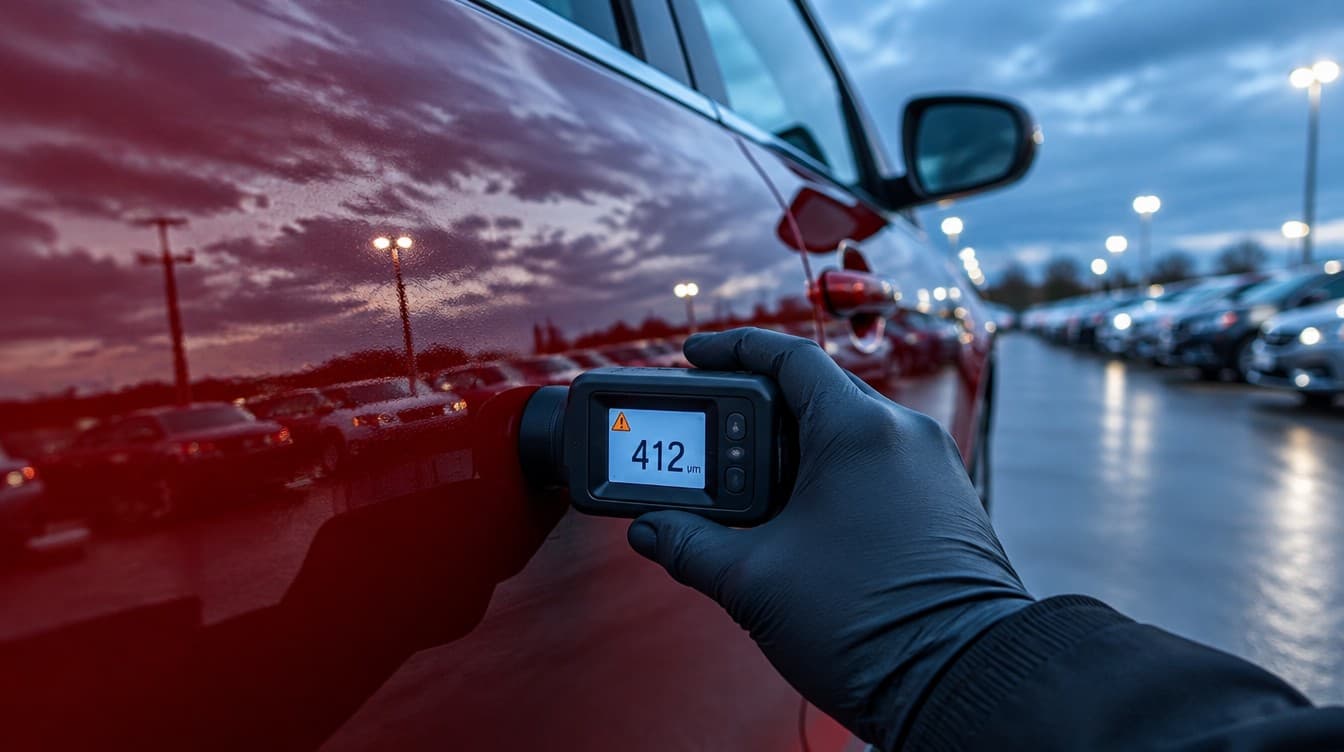
What reports miss: a history report only knows what was reported to it. CARFAX's own disclaimer says its reports are "based only on information supplied to CARFAX." A fender-bender fixed with cash at a body shop may not show up, but a buyer with a paint gauge (like the one in the photo above) may still find it.
How much does an accident lower your car's value?
It depends on how bad it was and how much buyers can see.
CARFAX has estimated that vehicles with reported past damage sell for about $400 less at retail on average, and severe damage costs about $1,500 (CARFAX via PR Newswire). Those are averages across all vehicles, so the dollar hit is bigger on more expensive cars. It's also common: CARFAX estimates as many as 40% of vehicles on U.S. roads have some damage in their history.
What moves the number most:
- Severity. A scuffed bumper and a frame repair are very different deductions.
- Structural damage and airbag deployment. These signal a serious crash and limit who will buy the car.
- Number of incidents. Two minor accidents can cost more than one.
- Repair quality. Mismatched paint, uneven panel gaps and warning lights tell a buyer the repair wasn't done right.
One accident doesn't make your car worthless. It changes who will buy it and for how much. CARFAX itself tells shoppers not to let a minor accident report steer them away from an otherwise good car (CARFAX).
How much does mileage matter?
Mileage is one of the main inputs in every valuation, along with age, equipment and condition (Kelley Blue Book). What matters is how your miles compare with what's normal for the car's age.
- What's normal: The Federal Highway Administration puts the average at about 13,500 miles per driver per year (FHWA). A 4-year-old car with 54,000 miles is right on average. The same car with 90,000 is well above it.
- The round-number effect: In an analysis of more than 22 million wholesale auction sales, economists found prices drop by roughly $150 to $200 each time a car crosses a 10,000-mile mark. Cars at 79,900 miles sold for about $210 more than cars at 80,000 (NBER Working Paper 17030).
Practical takeaway: If you're about to cross a round number, like 99,800 miles, it can pay to sell sooner rather than later.
What title brands do to your offer
A title brand stays with the car for life, so it has the biggest single effect on value.
| Brand | What it means | Effect on value |
|---|---|---|
| Salvage | An insurer declared it a total loss, or repair costs exceeded its value | Edmunds estimates up to 50% less than the same car with a clean title (Edmunds) |
| Rebuilt / reconstructed | A salvage vehicle repaired and inspected for road use | KBB says the usual rule of thumb is a 20% to 40% deduction (KBB) |
| Flood, fire or hail | Damage from that event was reported | Large, and many buyers won't buy them at all |
| Lemon / manufacturer buyback | Repurchased by the automaker over repeated defects | Lower value and fewer buyers |
| Not actual mileage / exceeds mechanical limits | The odometer reading can't be trusted | Large, because the true mileage is unknown |
Branded cars are also harder to insure and finance. CARFAX notes some insurers offer only liability coverage on rebuilt vehicles, and some lenders won't finance them (CARFAX). Fewer buyers who can get a loan means lower offers.
Can odometer problems lower your offer?
Yes, and they're a real problem. NHTSA estimates more than 450,000 vehicles are sold each year with false odometer readings, costing consumers more than $1 billion a year (NHTSA).
Buyers compare the miles on your dashboard with every reading in the history report. If a past reading is higher than today's, or the title says "not actual mileage," expect a large deduction or no offer at all, even if you didn't cause the problem. If you bought the car that way, keep your purchase paperwork to show when it happened.
Do open recalls lower your offer?
Usually not much, because recall repairs are free at any franchised dealer for that brand. NHTSA says manufacturers must fix the problem at no charge (NHTSA).
Still, check your VIN at nhtsa.gov/recalls before you sell. Getting an open recall fixed removes one more question for the buyer. The NHTSA lookup covers recalls from the last 15 years and doesn't list ones already repaired.
What else lowers an offer?
- Condition. KBB says most cars it sees are in "Good" condition, and that "most people tend to overestimate the condition of their car" (KBB). Curb-rashed wheels, worn tires, cracked glass and interior wear all add up.
- Warning lights and mechanical issues. A check-engine light makes buyers assume the worst.
- Missing keys. A second smart key can be expensive to replace, so buyers deduct for it.
- Smoke, pet odor or heavy stains. These cost real money to clean and reduce retail appeal.
- Aftermarket modifications. KBB generally doesn't add value for aftermarket items, and lifts, tunes and loud exhausts can shrink the pool of buyers.
- Local demand. The same car can be worth more in one market than another, and trucks, colors and trims fall in and out of favor.
What can you do before you sell?
- Check your own history first. Look at what buyers will see, and gather paperwork that explains anything odd.
- Fix open recalls. They're free.
- Find both keys and the owner's manual.
- Gather service records. Proof of regular maintenance builds buyer confidence.
- Be upfront about damage. A disclosed, well-repaired accident costs less than one a buyer discovers.
- Clean the car and take clear photos in daylight.
- Don't pay for big repairs just to sell. Repairs rarely pay for themselves at sale time, but cheap fixes like a burned-out bulb or a fresh wiper blade can help.
How does Maverick Motors make your offer?
We start from what cars like yours are actually selling for, then adjust for your car's history, mileage and condition.
- We pull a vehicle history report on every VIN, so the offer you see already accounts for reported accidents, title brands and odometer records.
- The offer is one firm number, not a range, and it holds for 7 days. Scan or enter your VIN or plate to see it in about 30 seconds.
- It's based on what you tell us. If the car doesn't match, for example the odometer reads more than 100 miles higher than you entered or there's damage you didn't mention, we may re-price it. You'll see the new number before anything is final, and you can decline.
- An open recall doesn't stop an offer.
- What we don't buy: salvage or rebuilt titles, cars that don't run or have major mechanical issues, and vehicles worth about $10,000 or less.
If you want a real number based on your car's actual history, get your Maverick Motors offer in about 30 seconds.
The bottom line
The biggest hits to an offer come from title brands, odometer problems and serious accident history, and you can't undo those. What you can control is honesty, paperwork and presentation. Know what's in your car's history before a buyer does, fix what's free, and get a firm number from a buyer who shows you the deduction before you agree to anything.
This guide is general information. Values vary by vehicle, market and buyer, and the figures above are averages from the sources cited.
Frequently Asked Questions
- How much does an accident lower a car's value?
- It depends on severity. CARFAX has estimated reported past damage lowers retail value by about $400 on average and severe damage by about $1,500. Structural damage and airbag deployments typically cost more, especially on higher-priced vehicles.
- What mileage is considered high for a used car?
- Compare against age. The FHWA average is about 13,500 miles per driver per year, so a car well above roughly 13,500 miles times its age is above average. Prices also tend to dip as a car crosses each 10,000-mile mark.
- How much less is a rebuilt or salvage title worth?
- KBB's rule of thumb for salvage or reconstructed titles is a 20% to 40% deduction, and Edmunds estimates a salvage title can cut value by up to 50%. Many buyers, including Maverick Motors, don't buy branded-title vehicles at all.
- Do open recalls lower my car's trade-in value?
- Usually not by much, because recall repairs are free at a franchised dealer. Check your VIN at nhtsa.gov/recalls and get open recalls fixed before you sell.
- Can an accident that wasn't reported to insurance show up on a history report?
- Sometimes. Reports only include what was reported to them, so a cash repair may not appear. But appraisers check paint thickness, panel gaps and repair quality in person, and undisclosed damage can still lower the offer.
- Does Maverick Motors check vehicle history before making an offer?
- Yes. We pull a history report on every VIN, so your firm offer already reflects reported accidents, title brands and odometer records.